
Read Pulaski County Property Tax Records
The duties split cleanly. The Board of Tax Assessors appraises property, equalizes values, and reviews appeals, while the Tax Commissioner bills, collects, and disburses the revenue. One office controls value; the other controls the ledger.
| Field | What It Shows | Where |
|---|---|---|
| Fair-market value | The assessor's estimate under Georgia valuation rules | Tax Assessor card |
| Assessed value | Ordinarily 40% of fair-market value | Tax Assessor |
| Exemptions | Approved reductions or special programs | Tax Assessor |
| Bill and payments | Charge, credits, balance, and status | Tax Commissioner |
| FIFA or sale record | Later collection and enforcement stage | Commissioner and Clerk |
Georgia usually assesses at 40% of fair market value. One mill means one dollar per thousand of assessed value. From there the formula runs: assessed value minus exemptions, multiplied by the millage rate, and none of those figures equals the last sale price.
Pulaski County's December 1 Due Date
Pulaski County property taxes come due on December 1, according to Tax Commissioner's published guidance. Many Georgians assume December 20. Pulaski works differently. If you mail a payment, the local guidance counts the USPS postmark. That postmark date serves as the date of payment.
Check the current bill for the exact amount and deadline. Local action or a change in law can move a due date. So last year's calendar is not a safe guide. This quirk matters for anyone tracing a property records search across multiple years.
Note: Keep the tax year attached to every balance and receipt. That way a prior delinquency is never mistaken for the current bill.
The official Pulaski tax information page gathers the local due date, office roles, exemptions, appeal rules, and delinquency steps into a single source. Bookmark it before digging deeper.
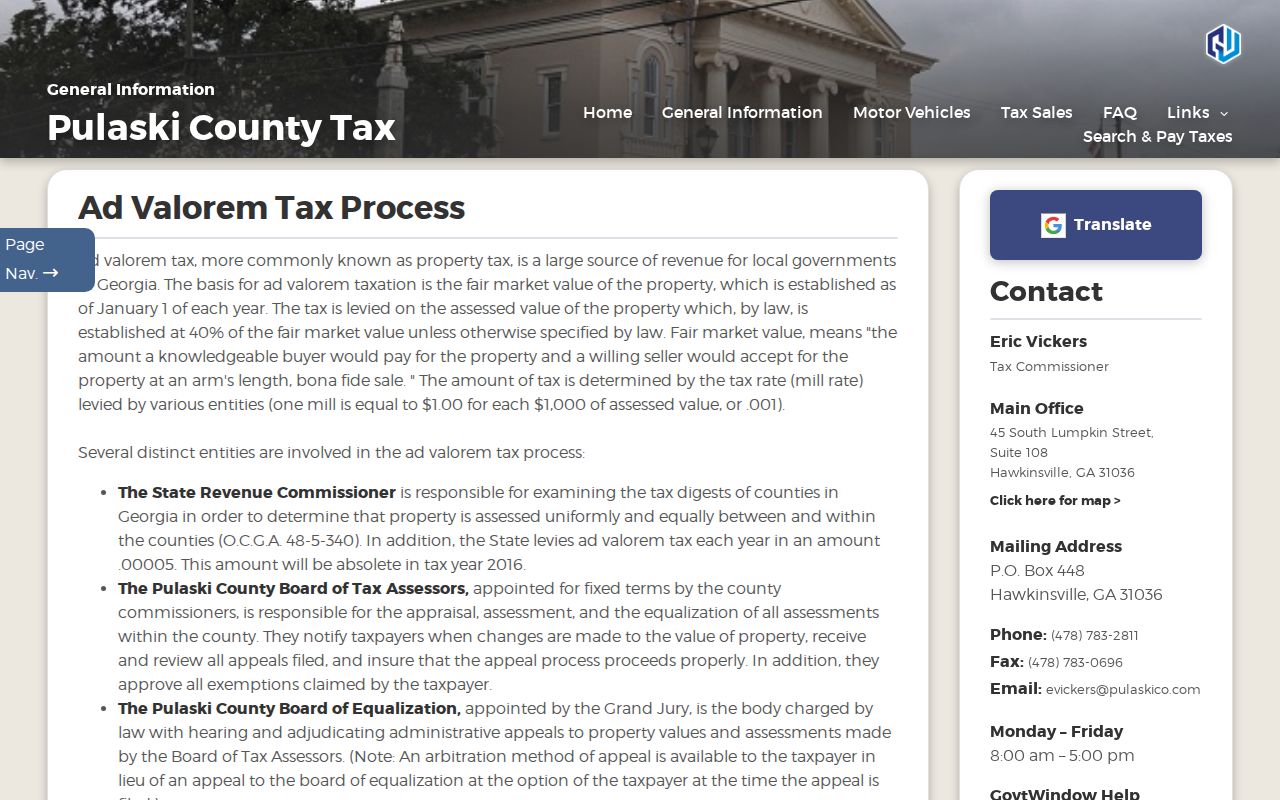
That page is a checkpoint, not the final word. Each current bill and assessment notice controls its own amounts and filing deadlines.
Separate Pulaski Assessment Work from Collection
Questions about appraised value, parcel characteristics, exemptions, assessment notices, or appeal files go to the Tax Assessor at 45 S. Lumpkin Street, 478-892-3564. Questions about bills, payment history, delinquency, FIFA, and tax sales go to the Tax Commissioner at 478-783-2811.
This split matters when two records disagree. A tax bill can carry an earlier owner while a newly recorded deed shows a transfer. qPublic's “most current published” digest language does not promise a real-time closing update. Record the update date for each source.
Look Up a Pulaski County Tax Bill
The GovernmentWindow tax endpoint handles online payments for Pulaski County tax bills. Pull the assessor card first. That way the parcel number and tax district are already in hand.
- Find the parcel in qPublic and copy its number, location, district, and owner string.
- Use the parcel or account key at GovernmentWindow and select the correct tax year.
- Compare billed value and exemptions with the assessor card.
- Save the ledger or receipt, then ask the commissioner about any unexplained status.
- Check a claimed FIFA or sale against the Clerk's recorded instrument.
- Assessed value
- The value used in the tax formula, ordinarily 40% of fair-market value in Georgia.
- Millage
- The rate applied per $1,000 of assessed value.
- Homestead exemption
- Approved relief tied to a qualifying principal home.
- FIFA
- A tax execution filed as part of collecting unpaid tax.
Identify Pulaski County Exemptions and Covenants
Pulaski County guidance lists a long menu of relief. Options include standard homestead, elderly school and general exemptions, disabled-veteran and surviving-spouse relief, floating homestead, age-65 state ad valorem relief, agricultural assessment, conservation use, historic, brownfield, timber, and freeport. Eligibility and filing rules differ.
The general homestead deadline is April 1. Conservation use can carry a ten-year covenant, so it is not a simple yearly discount. Check the Georgia DOR homestead material and local forms. Then confirm approval on the Pulaski assessment record.
Follow Pulaski Delinquency Without Assuming a Sale
Interest runs at the prime rate plus three percent, divided by twelve. Penalties stack quickly. A five-percent penalty applies after 120 days, with more at each 120-day interval up to 20%. The Clerk may receive a FIFA 30 days after the delinquent notice, and later steps can include levy, advertisement, and sale.
The official tax-sales page currently lists no sale date. A delinquent balance is not proof of sale. A sale notice is not proof that title changed. Pull the tax ledger, notice, FIFA, deed, and any release or redemption record.
Follow the record trail. Redemption rights and title effects require the recorded instrument and current legal advice, not an inference from a tax balance.
The Pulaski County tax-sales page marks the official route for sale notices. It lists no current parcels or dates.

Call the Tax Commissioner, then check the deed with the Clerk.
Handle Pulaski Mobile-Home Tax Records
Mobile homes are personal property for tax purposes. Local rules require the tax and a location permit by April 1. A ten-percent penalty applies for missing the deadline. The appeal period stays 45 days. The Board of Equalization hearing follows within 21 days after notice.
Ask what a record covers: home, land, or both. Address matching can mislead, joining records with different owners or account numbers.
Note: A mobile-home location permit is not a deed to the underlying Pulaski County parcel.
Request Pulaski Tax Records Beyond the Portal
Start with the assessor. Ask for a parcel card, assessment notices, card history, exemption file, appeal file, and last-update date. Then ask the commissioner for the year-by-year bill, payment ledger, delinquency notices, FIFA details, and sale records.
Put the request in writing. A focused letter can follow the Georgia Open Records Act process, naming the parcel, year range, record type, and preferred electronic format. Three business days is the usual response window. The Act permits lawful labor and copy charges.
Verify a Pulaski Appraisal Visit
An assessor's notice cites O.C.G.A. §48-5-264.1 and lists the reasons an appraiser might visit: an appeal, a tax return, construction, revaluation, parcel review, conservation use, or personal-property work. A legitimate visitor carries photo identification and drives a marked county vehicle.
If the identity is uncertain, call the assessor's published number before sharing anything. Remember what a visit means. It supports appraisal work only, and it is never evidence that a deed, a tax bill, or a zoning status has changed.
Calculate Pulaski Tax Fields Without Mixing Values
Build the value worksheet the same way every time. Capture the year, land value, improvement value, total fair-market value, assessed value, exemption amount, taxable value, and millage components when the parcel card lists them. Before comparing years, confirm the same parcel number, district, and exemption status.
Georgia's ordinary rule assesses property at 40% of fair market value. A fair-market figure and an assessed figure are not interchangeable. Subtract any approved exemptions from assessed value first, then apply millage. A sale price answers a different question, and it surfaces through deed or PT-61 data rather than the tax bill.
One caution about older samples. A 2012 sample card showed a Hawkinsville millage of 32.98, but a historical sample is not the current rate. For present calculations, rely on the current bill and official millage documents.
Preserve Evidence for a Pulaski Appeal
Keep the notice envelope. Its postmark starts the 45-day clock. File it with the assessment notice, the full parcel card, the legal description, photographs, exemption papers, and a set of comparable Pulaski parcels chosen on a consistent basis. State one clear ground. Taxability, value, uniformity, or exemption denial are the accepted choices. The Board of Tax Assessors reviews the filing first, and a later route may run to the Board of Equalization or arbitration and then Superior Court. Every stage carries its own deadline. Retain proof of filing and delivery throughout. A real-property tax return filed between January 1 and April 1 is simply the taxpayer's declaration of a value or change. The Board still sets the assessment, and a public search that turns up no return does not prove that no transfer or change occurred.
Contest a Pulaski County Assessment
Pulaski County owners get 45 days to appeal. The clock runs from the mailing date on the assessment notice, and the accepted grounds are taxability, value, uniformity, or denial of an exemption. The tax amount alone is not a ground. File first with the Board of Tax Assessors, following local instructions or the Georgia PT-311A form, which the state appeal page provides. Preserve the envelope and the property card. Comparable parcels, photographs, the legal description, and exemption documents all strengthen the file as the appeal moves forward. Paying the bill is separate from contesting it. The route may continue from the Board of Tax Assessors to the Board of Equalization or arbitration, and then to Superior Court.
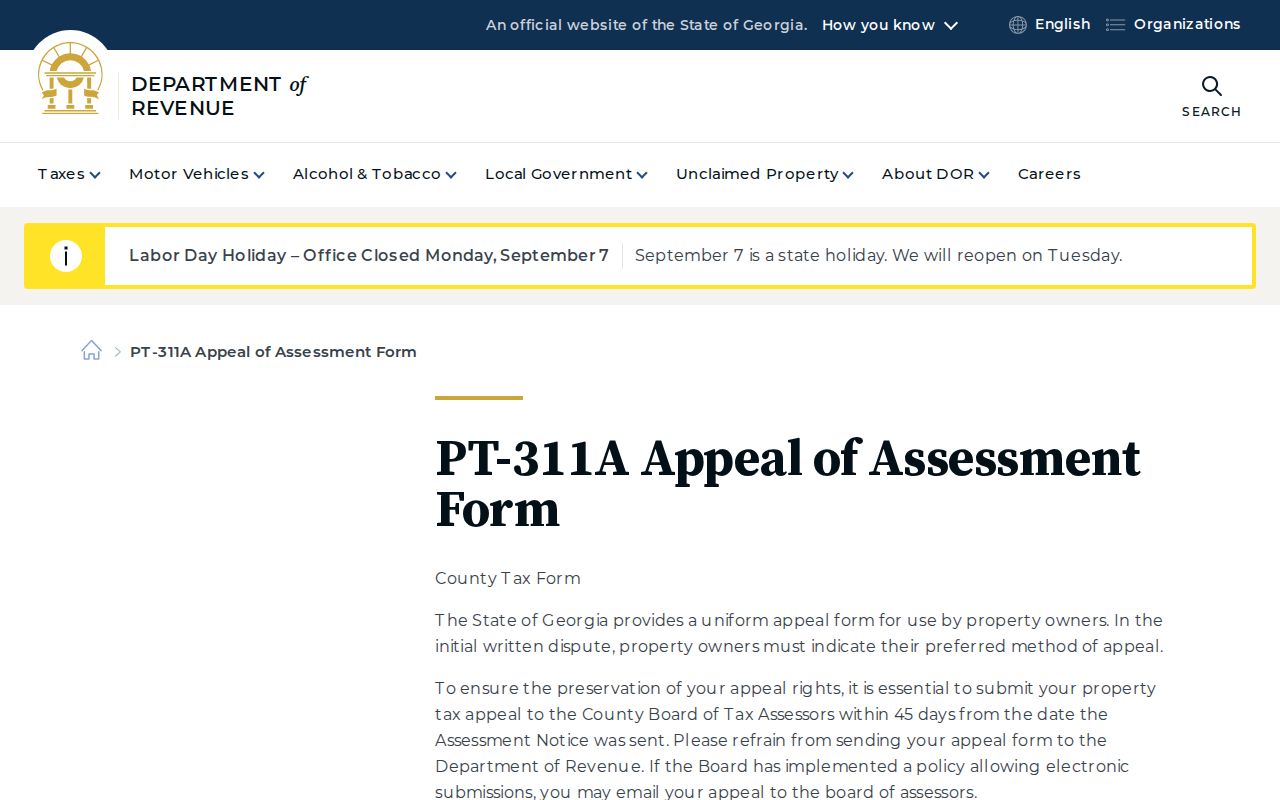
The PT-311A route still runs locally. File with the Pulaski County Board under the notice instructions rather than with DOR, since the county board rules on your parcel's value.
Appeal window. File within 45 days of the notice mailing date with the Pulaski County Board of Tax Assessors and keep proof of delivery.